
At Weekdone, we’ve been in the OKR software market for over 10 years. We’ve developed a goal management solution to empower your teams to work toward the right business metrics through the OKR (Objectives and Key Results) methodology.
This guide provides you with the most important elements of the framework so businesses can move forward, grow, and lead with confidence.
Try OKR Software 🎯
Set and track OKRs in Weekdone OKR software with built-in examples, guided OKR Wizard, color-coded tracking, and visual dashboards. Stay focused – achieve goals.
OKR Definition and Meaning
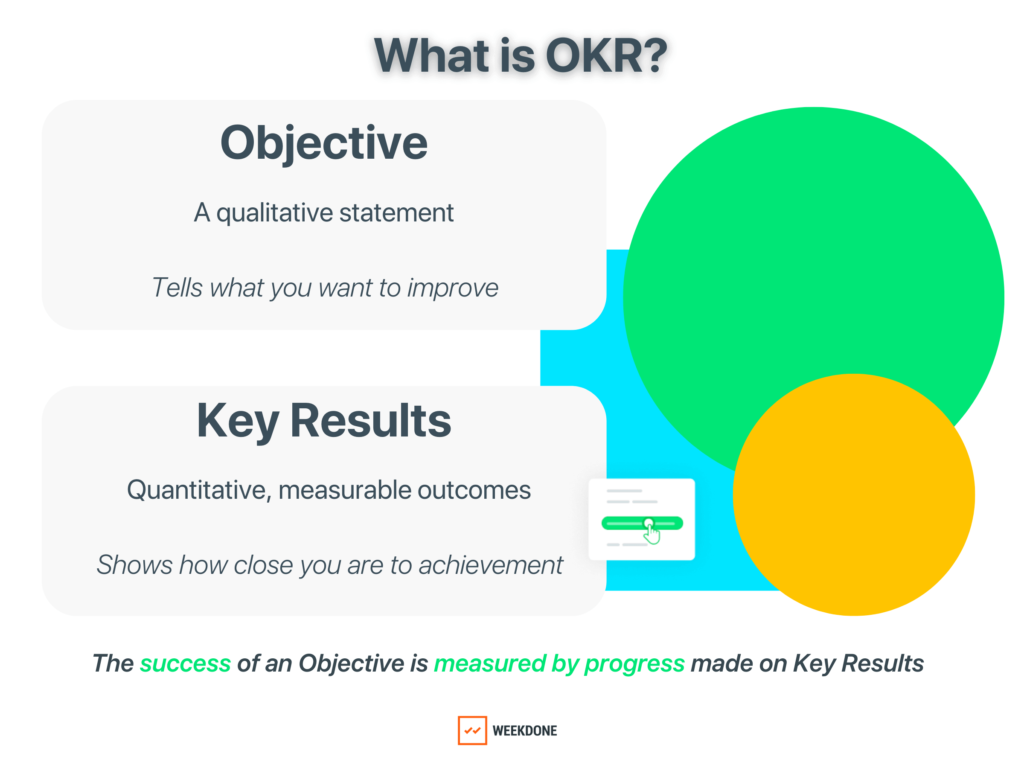
OKR stands for Objectives and Key Results. It is a goal-setting framework that consists of two basic components:
The Objective
is qualitative and reminds you of what you set to improve.
The Key Results
are quantitative, measurable outcomes you need to deliver to help achieve the Objective.
The OKR meaning
The meaning of OKR is different depending on which company level you set them on.
At Weekdone, we follow goal alignment best practices – therefore, we recommend setting only Objectives on the company level and both Objectives and Key Results for other levels in your company.
This bottom-up alignment gives teams ownership of the Company Key Results, contributing to the Company Objective as progress is made on team OKRs during the quarter.
Here are the 5 company levels you may have in your organization:
- Company
- Cross-Functional Team
- Department
- Team
- Personal
📚 Read about the OKR hierarchy
Who Created OKRs?
The Objectives and Key Results framework didn’t appear all of a sudden, and other goal management techniques had been used before such as MBOs, SMART goals, and KPIs.
Weekdone started providing OKR Software more than 10 years ago and has been used by thousands of companies to run their OKR process.
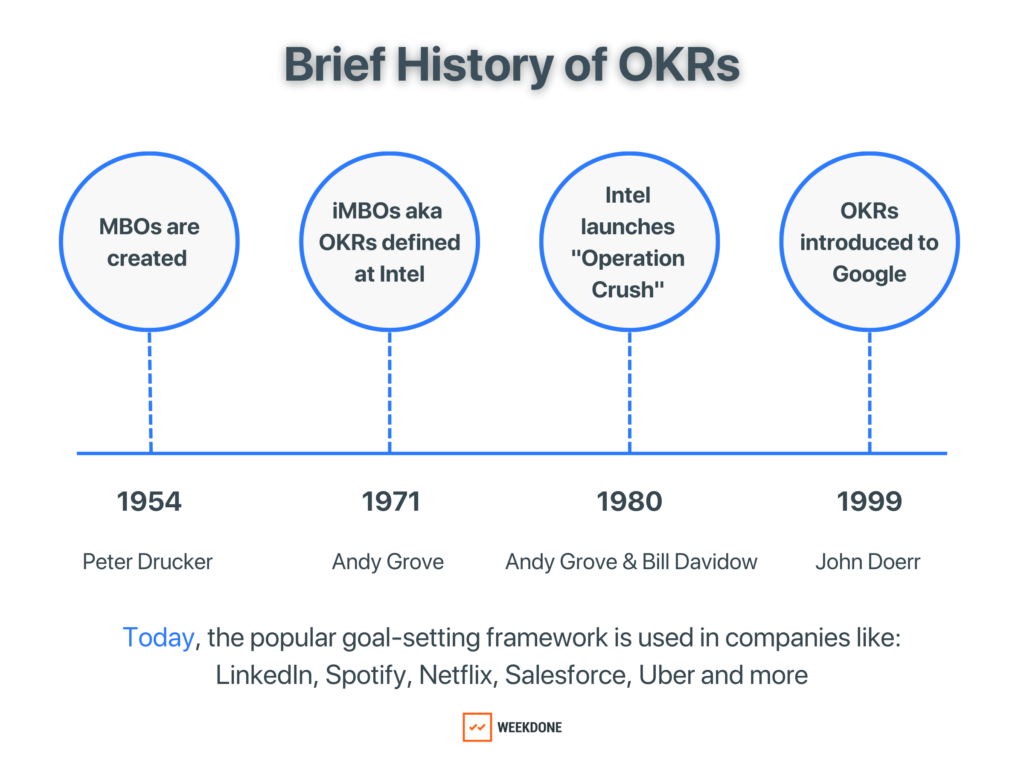
In 1954 Peter Drucker formed the technique, Management By Objectives (MBOs), which grew in popularity thanks to its success in helping businesses as well as Drucker’s book, The Practice of Management.
In the 1970s Andy Grove, CEO at Intel, took the idea of Objectives and merged them with Key Results to create what we now know as OKRs. He called them iMBOs (Intel Management by Objectives), however, Objectives were never spoken about without mention of the Key Results.
Within the next few years, John Doerr learned the methodology from Andy Grove and introduced OKRs to Google. Doerr’s simplified formula: I will (Objective) as measured by (this set of Key Results).
As an outcome-driven framework, OKR management famously helped Larry Page and Sergey Brin to take Google to new heights, and thousands of companies have learned to leverage the principles of the method ever since.
Objectives and Key Results have helped lead us to 10x growth, many times over. They’ve helped make our crazily bold mission of ‘organizing the world’s information’ perhaps even achievable. They’ve kept me and the rest of the company on time and on track when it mattered the most.
Larry Page, Co-Founder of Google
Today, leaders in LinkedIn, Twitter, Slack, Spotify, Uber, and Microsoft use the OKR methodology to communicate improvement priorities across the company and align the teams to move in the right direction.
How to Write Good OKRs
Writing good Objectives and their driving Key Results takes time, experience, and critical thinking. 📝
In Weekdone OKR software we offer features to help teams write better OKRs, sign up for a 14 day trial and test the OKR wizard, or use example data and immediately start working toward those measurable goals.
How to write Company Objectives
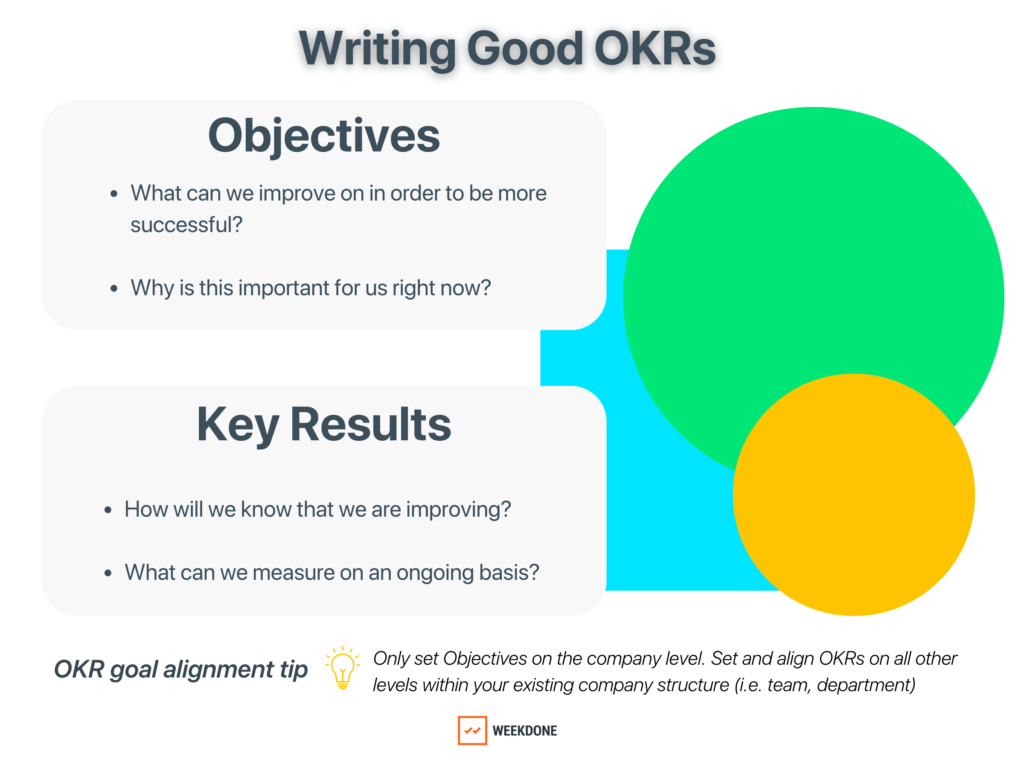
A Company Objective should be a high-level improvement area that several teams can contribute to through their daily work and longer term projects.
It should be broad in the sense that teams can brainstorm impactful team OKRs, yet specific enough to provide a clear direction for the quarter.
Before finalizing high-level objectives, leadership should ask for feedback from the teams and clarify expectations.
How to write Team Objectives
Team Objectives are inspirational goals aligned with the overarching company direction. They should give the team purpose, a sense of urgency, and focus.
Team Objectives are not projects, they are problems to solve or the most impactful improvement opportunities to pursue within a quarter.
A team (as a group of people working towards the same outcomes) should be responsible for writing their collaborative goals. Starting with writing a good objective, a team would need to answer the questions:
- What is our role in driving the Company Objective forward?
- What can we create (innovate), fix (resolve), or improve (change) in order to be more successful?
- What is stopping us?
How to write Key Results to an Objective
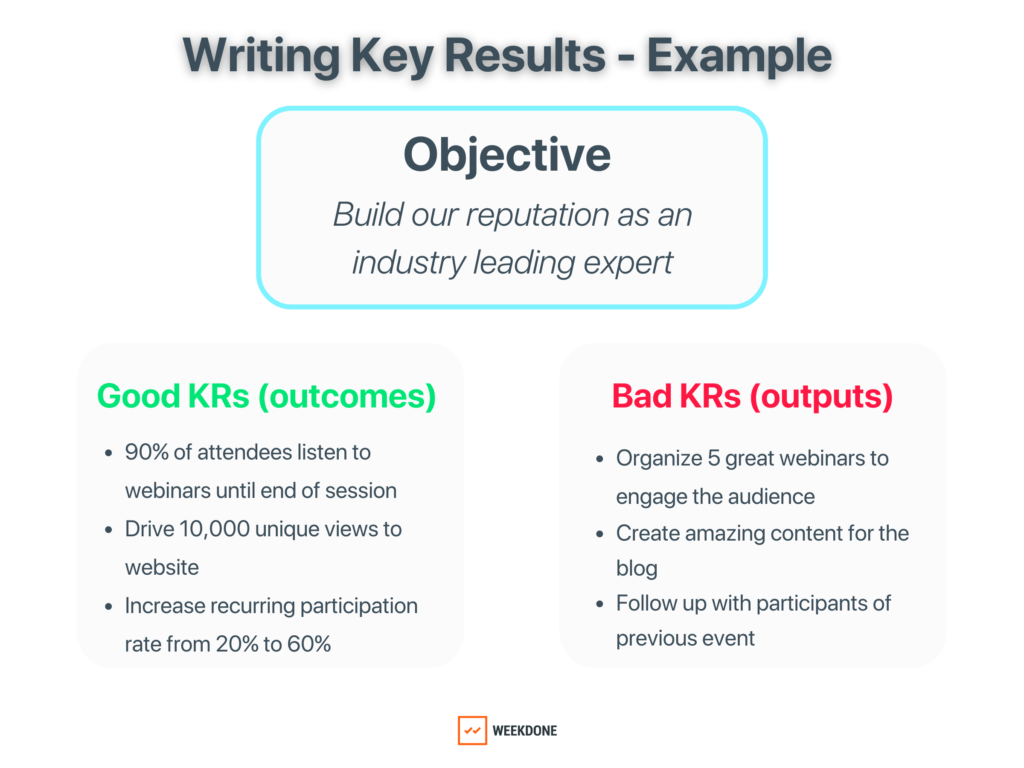
Key Results are the measurable outcomes that represent a valuable change in the business – indicating how close to reaching the objective you are.
Under each Objective, a team would set 3-5 Key Results.
👉 Note: Key Results are not activities you complete. They are the outcomes of those activities.
For example, if you complete 3 bigger projects, what kind of immediate business impact do you expect to see during that quarter? That would be the desired outcome.
Measure Business Value as Outcomes
- Customer acquisition outcomes – daily active users, registrations, participants, number of sales meetings, onboarded clients, calls, interviews with partners.
- Interaction outcomes – unique views or reads, website conversion, completion of onboarding steps, number of clients using a new feature, click-through rate, open rate, success rate, bounce rate, new traffic.
- Outgoing communication outcomes – pre-orders, leads, new deals closed, new hires.
- Financial outcomes – ROI, cost efficiency, LTV, deal size, average transaction value.
- Efficiency outcomes – page loading speed, number of bugs-related customer support tickets, average response speed, customer satisfaction score.
💡Pro Tip: If you set an Objective and you can’t think of any ideas to help you achieve it, then it is not actionable. While writing your OKRs, discuss what initiatives will help drive the Key Results forward. This way you will see if this goal even makes sense.
Try OKR Software 🎯
Set and track OKRs in Weekdone OKR software with built-in examples, guided OKR Wizard, color-coded tracking, and visual dashboards. Stay focused – achieve goals.
Avoid these common OKR writing mistakes
- Always start by defining an Objective for a quarter
- Write at least 3 and no more (!) than 5 Key Results per Objective
- Make them ambitious but not impossible
- a Key Result is not an activity, it is the desired outcome of a series of activities
- Make sure it is time bound (usually quarterly) and you have ideas on how to drive it (Initiatives)
- Key Result is not any regular business-as-usual KPI (business metric), it should define the success of your Objective
- A team’s actions should have a clear impact on Key Results during the quarter
- If you look at a Key Result and have no initiatives or action plans for driving it, it’s not a good Key Result
Start a company trial for unlimited users. Invite your teams today.
OKR Examples
Now that you understand how to write good Objectives and Key Results, let’s take a look at some team examples to level up your learnings.
Here are some practical OKR examples for different teams.
Marketing Team
Objective
Improve promotional channels to generate more Marketing Qualified Leads
Key Results
KR1: Increase email marketing MQLs from 100 to 150
KR2: Increase AdWords MQLs from 70 to 100
KR3: Increase organic search MQLs from 45 to 50
Product Team
Objective
Research and map signups’ first product entry expectations and needs to improve areas that actually matter
Key Results
KR1: Analyze learnings from at least 100 Inspectlet recordings
KR2: Analyze learnings from at least 30 interviews with early-stage customers
KR3: Analyze signup funnel and figure out at least 5 main reasons for the drop-off
Sales Team
Objective
Personalize sales approach and nurture new potential customers better
Key Results
KR1: Improve conversion % from “trial” to “paid” from 20% to 35%
KR2: Increase follow up email open rate from 14% to 45%
KR3: Reach 8/10 average score on customer satisfaction survey with at least 100 responses
👩🏻💻 Browse more: team-specific OKR examples
OKR examples in Weekdone
As you’re drafting OKRs for a new quarter in your team, we know how helpful examples can be to spark new ideas. So rather than searching the internet, we’ve included them in Weekdone OKR Software!
Simply go to your Quarterly Objectives dashboard, click to add a new objective, then choose “see examples” to review hundreds of examples for different teams! This sample data is easily customizable, so you can change, edit, and tailor to your team needs as your discussions continue.
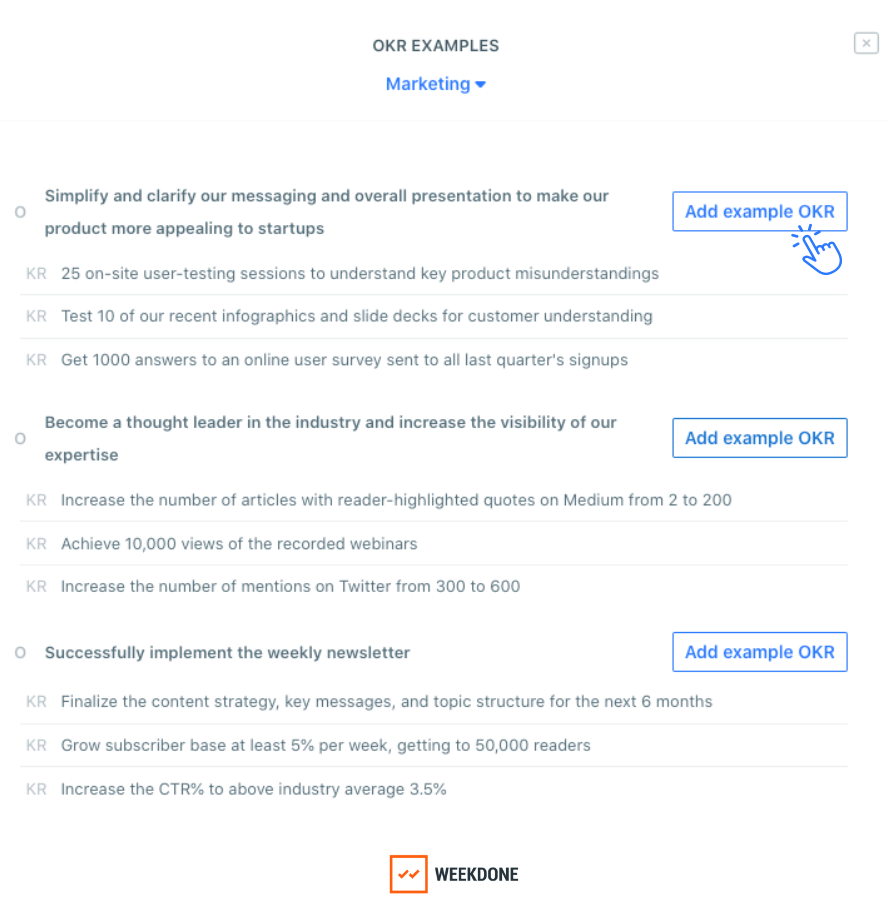
More examples are available in Weekdone OKR Software for the following teams and departments:
- Accounting/Finance
- Design
- HR
- Marketing
- Leadership
- Product Management
- Sales
- Support/Customer Service
- Tech/Engineering/R&D
- Training & Education
- Operations/Admin
- and more!
The OKR Process
As you’re now familiar with the methodology and how to write good OKRs for your team, it’s time to execute your goals.
Without the right process, the Objectives and Key Results methodology can quickly become just like any other goal setting technique – abandoned due to unrealistic expectations. So, to help guide your journey – let’s take a look at the process behind a successful quarter.
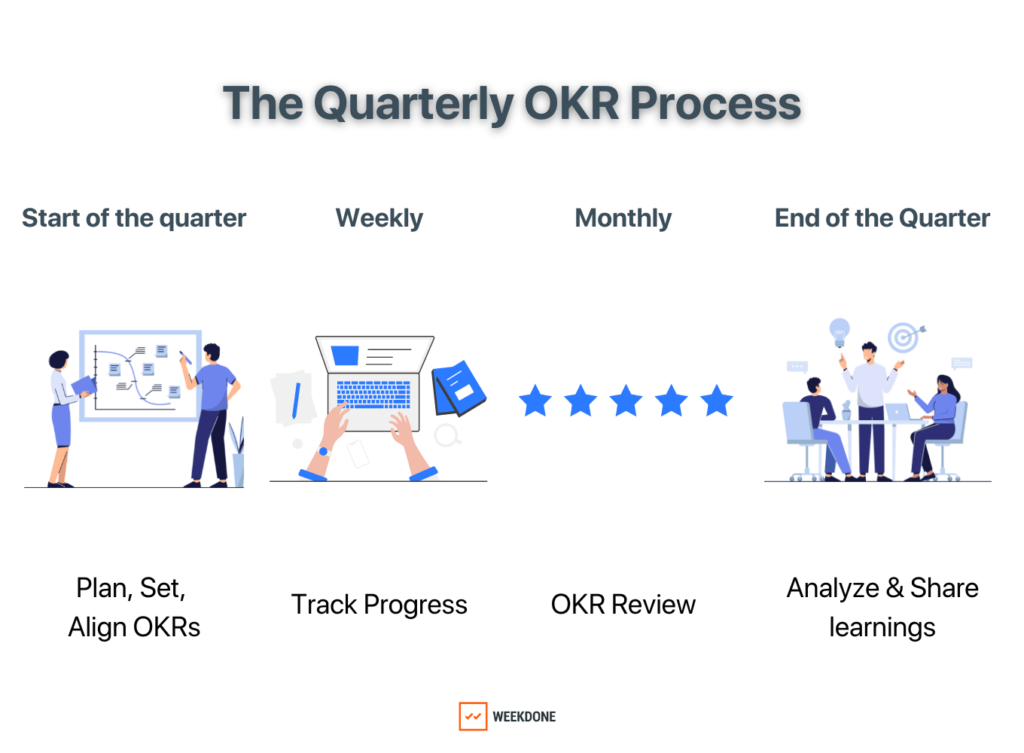
1. Start of the quarter
Plan, Set and Align
At the beginning of a quarter, teams will plan their OKRs. Start by analyzing your role as related to the big picture company Objective. From there, solidify your OKRs based on what your team feels will yield the biggest impact for a new quarter.
Setting OKRs in dedicated software is the easiest way forward, simply choose your team, then add the Objective and Key Results with beginning and ending target points with custom metrics.
OKR software is especially helpful for goal alignment. For example – linking team OKRs to the company Objective will make tracking much easier during the quarter. Visualise how teams contribute to the big picture while every team has their own Key Results to follow through on.
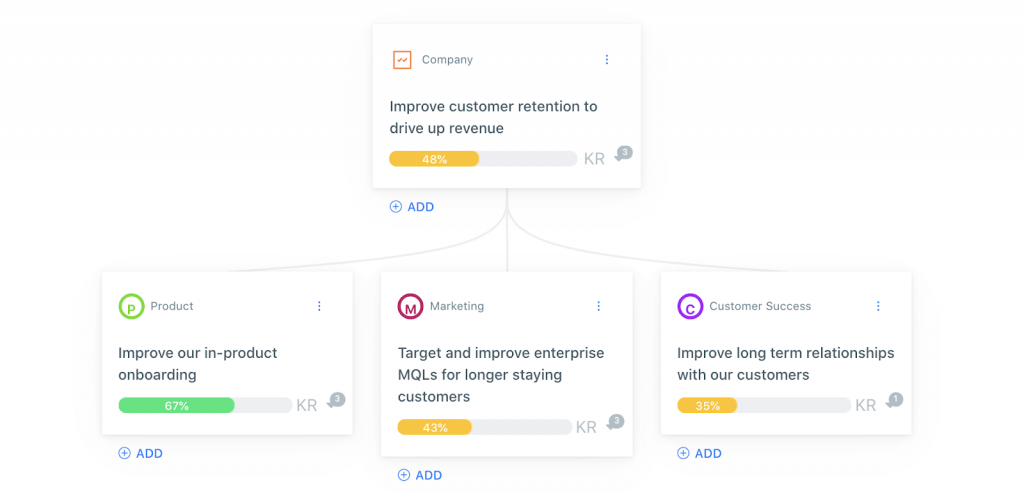
2. Weekly
Track Progress
As weeks progress, focus stays on the OKRs, but moves to the “how” stage. What will individuals do in order to move progress each week?
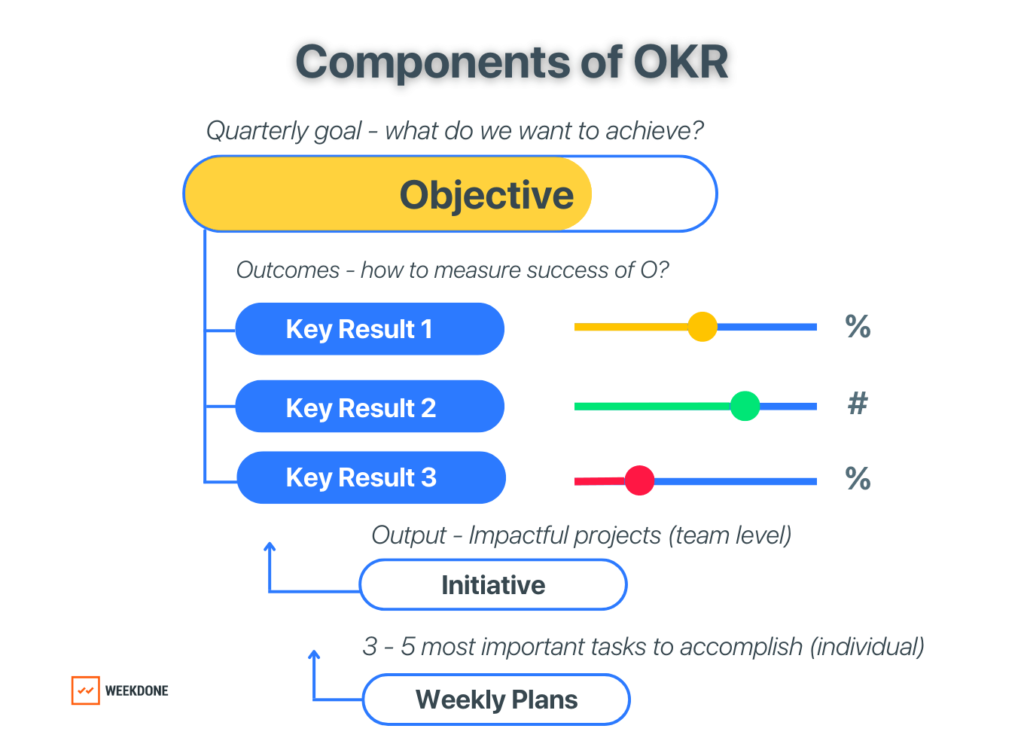
Two components of OKR that are useful for the execution (output) stage are:
- Initiatives – Sometimes referred to as: projects, activities, or the ideas planned by a team in order to move the needle forward on quarterly OKRs.
- Weekly Plans – individual employees set 3-5 weekly tasks that remind them to focus on the most impactful plans while keeping team goals in mind. Using the PPP methodology in Weekdone, everyone should set plans, share progress, and report challenges during a week’s time.
Weekly planning drives the OKRs forward by focusing your attention on what you need to do during the week.
Weekly Meetings
There are 3 types of meetings that can help move progress along:
Execution Meetings: Otherwise known as sprint planning, these happen every other week. Everyone shares the most important plans for the next 2 weeks, and in the following meeting discuss whether those were delivered or what got in the way of completion. This holds people accountable and opens up the conversation for other teams to chime in ideas or other points of discussion.
OKR progress update: On the 2nd week (and every other thereafter) all teams should come together and share OKR progress – give your best interpretation of why things are, or are not progressing.
Team OKR Check-Ins: Your team OKR check-ins happen each week, it’s a quick 15-20 minute meeting where teams meet to reflect on the progress of their OKR, and set new priorities for the upcoming week. Also discuss the progress of weekly plans, results, and lessons learned.
3. Monthly & End of the quarter
Analyze and Share learnings
The core value of the OKR methodology comes from learning as you go, tracking progress, staying humble and trying new things.
Every month, the company should hold an OKR review. This is a time for asking questions from teams outside your own and moving forward with clarity.
When asked how to hold an OKR review (AKA: retrospective) it’s most important to remember the following:
- have an open and honest but respectful culture
- share constructive feedback
- ask the right questions
- have valuable discussions to complement the answers.
🎯 Free Download: Use our Retrospectives Miro Board Template to help facilitate a more engaged team during your quarterly review!
Questions to ask in your next OKR review
Try OKR Software 🎯
Set and track OKRs in Weekdone OKR software with built-in examples, guided OKR Wizard, color-coded tracking, and visual dashboards. Stay focused – achieve goals.
Benefits of OKR framework
With a new framework, you’re creating a more results-oriented and data-driven management style, rather than an output-focused, command-and-control approach.
Here are 4 reasons why OKR framework is your “go-to” goal management solution:
1. Stay focused on what’s important
By connecting Company and Team Objectives, employees are more in-tune with where priorities lie. Aligning daily tasks with strategic goals helps everyone understand how a teams daily activities satisfy the company vision.
All the team members understand how their Key Results contribute to the Company Objective, which makes it easier for that Key Result to remain top of mind during the quarter.
Start a company trial with unlimited users for 14 days.
2. Connect and align across the organization
It is not enough to write down a company’s goals and teams’ OKRs in a shared digital workspace and expect everyone to be on the same page. The framework assumes proper alignment with it’s hybrid approach: top-down and bottom-up.
- Top-down
Leadership should explain and clarify the company-level direction so that the teams have enough input to write their OKRs for a quarter.
- Bottom-up
Once teams have drafted their OKRs, they may decide to present them to the rest of the company and answer questions that might come up.
Before finalizing the OKRs for a quarter, teams also figure out dependencies with each other. This helps companies move forward toward a more connected culture with collaborative efforts.
3. Track for accountability and transparency
Company OKRs are improvement goals, and achieving some of them will require collaboration from teams in different functional areas.
Each team works towards their own OKRs as a group, and get together on a weekly basis for a quick team check-in meeting to make sure their staying on track – this could be apart of your regular team meetings.
Apart from the regular progress update and staying in sync, the point of these meetings is to ensure regular exchange of information that will improve mutual understanding, and build trust.
4. Drive improvement with actionable goals
You can choose how bold your goals would be: committed goals or aspirational ones.
Committed goals
Those your team knows how to achieve so they fully commit to attaining 100% on the progress bar.
Aspirational goals
May not be achieved 100% but they are important for growth and ongoing improvement.
Quarterly Objectives on the company level should be broad enough so that several functional teams can approach them from their different angles, but also specific enough so that there is a common direction.
Three months is enough time for a team to deliver valuable outcomes. During this time they will learn what works best and adjust their focus areas for the next quarterly cycle.
On a quarterly cycle, teams have four chances per year to respond to real world changes. Unlike with annual reviews where teams realize they’ve been on the wrong path for a year.
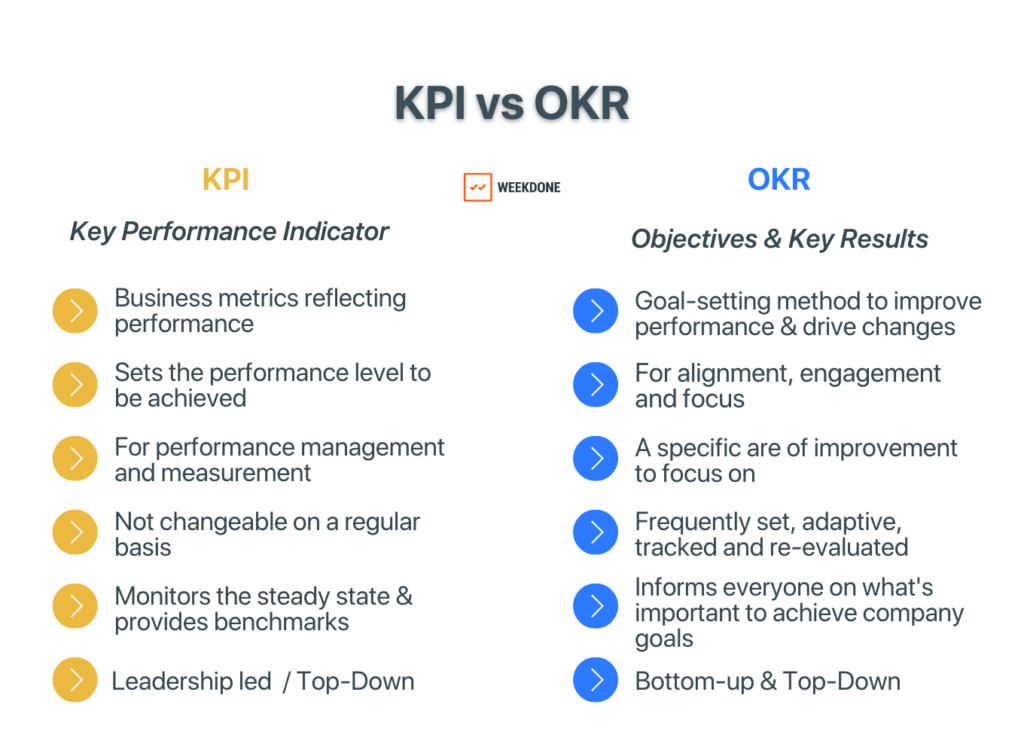
OKRs vs KPIs
Many people ask us: what’s the difference between OKRs and KPIs? Here are the cliff notes:
KPIs
KPI stands for Key Performance Indicators. KPIs are a unit of measure that companies use to track business metrics that reflect performance.
OKRs
OKR stands for Objectives and Key Results – it’s a goal management methodology that encourages businesses to define improvement areas and drive changes.
KPIs don’t tell you what needs to be changed or improved to drive the growth of your business metrics whereas OKRs help you clearly see how your business metrics relate to your daily work.
That isn’t to say your company can’t use KPIs. In fact, many companies use KPIs and OKRs together. OKRs are set alongside KPIs to help measure the impact of your performance metrics.
In Weekdone, you can report KPIs – let KPIs coexist with OKRs!
Put your new knowledge to the test with our OKR Quiz
Try OKR Software 🎯
Set and track OKRs in Weekdone OKR software with built-in examples, guided OKR Wizard, color-coded tracking, and visual dashboards. Stay focused – achieve goals.
Best OKR Tools
A goal management solution should suit some of the most common needs:
- Ease of use
- Progress tracking
- Reporting & analytics
- Teamwork capabilities
- Integrations
- Pricing and free trial options
- OKR coaching and support, etc.
There are many different tools to choose from. Below you’ll find the most popular ones that offer a free trial as well.
4 Popular Solutions
Weekdone
Best for setting quarterly OKRs and alignment
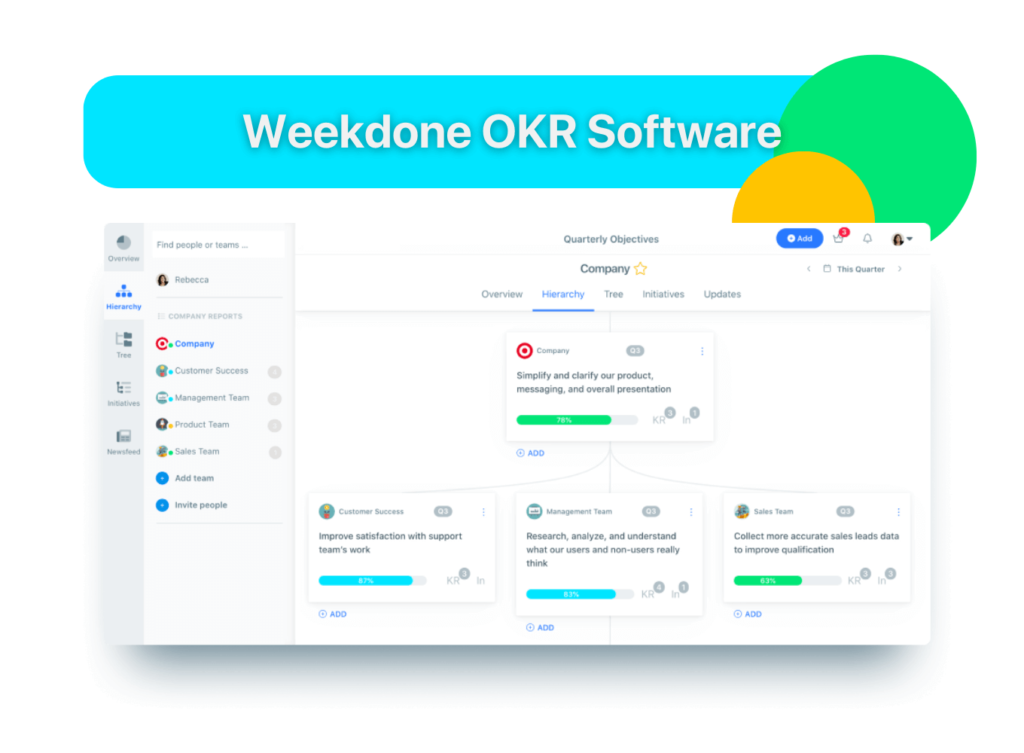
Weekdone is your solution for status reporting, aligning team OKRs with company-level Objectives, and visualizing your weekly and quarterly progress. Additional features support cross-functional team engagement.
Key Features:
- OKR hierarchy view lets you and your team visualize your company’s OKRs and their alignment across the entire organization;
- Weekly Check-ins help you connect your weekly plans with team Objectives to make sure that what you do each week is relevant to team quarterly improvements;
- Integrations with Slack, Asana, Jira and Google Tasks to keep the entire company updated about your biggest priorities and progress while using your favorite project management tool;
- TV dashboard feature that offers a bird’s eye view of your organization’s OKRs in addition to regular reports that you can export in a PDF or Excel format.
Bonus feature: Weekdone subscribers can receive company-tailored unlimited OKR Coaching to speed up the learning curve and gain helpful tips.
Koan by GTMhub
Best for 360-degree feedback and employee engagement
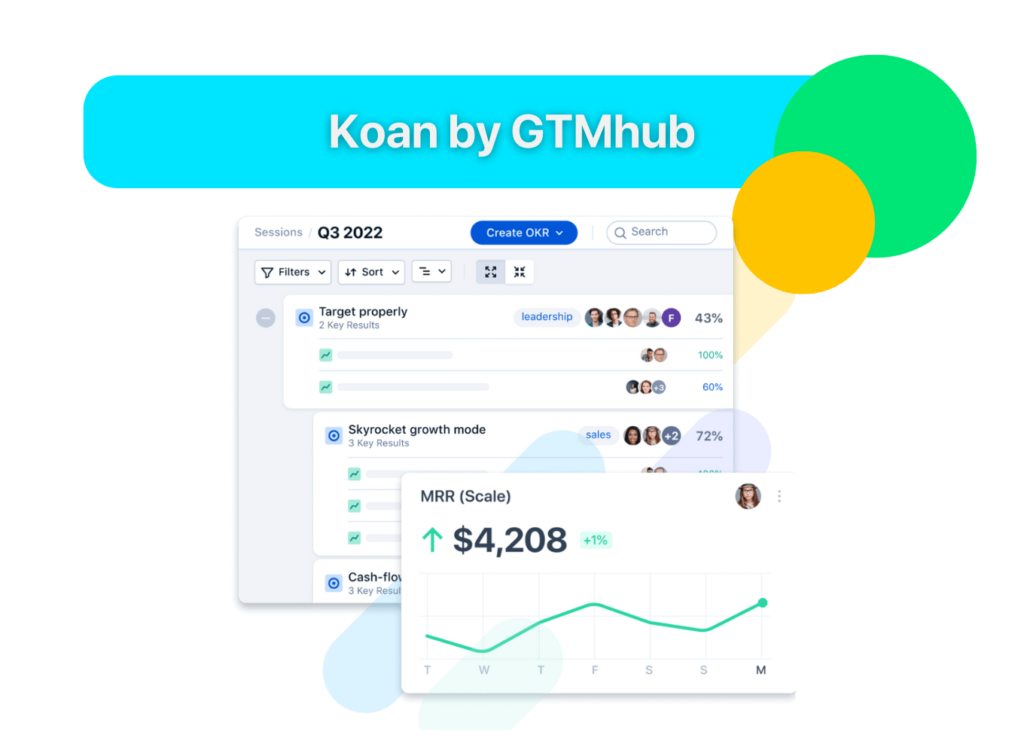
Koan’s free software helps companies of all sizes achieve goals through simple, positive habits embraced from the bottom up. Koan allows easy setting of OKRs and their owners, and the weekly reflections feature is great for keeping the team engaged and aware of their progress.
Key Features:
- Negative feedback management to let team members fill up quick, weekly reflections and share their accomplishments, top priorities and potential concerns;
- Progress Tracking gives visibility across your teams, trackable progress and viewable insights
Perdoo
Best for connecting KPIs and OKRs
Perdoo’s software offers OKR-related views and focuses on the Objectives and Key Results only. It’s easy and intuitive to set up and update goals.
Key Features:
- Groups feature to create teams and assign responsibilities and enable clearer execution and exercise accountability;
- KPI Monitoring for tracking each team’s OKRs and KPIs alongside each other and 360-degree transparency across the business.
👀 Discover more: 24 top OKR software solutions
Free Templates
Best to support the OKR framework process
There are different types and use cases for these templates. Weekdone has created a list of templates to support each step of the process.
Whether your reporting and tracking method is software, or a template – the drafting and review templates can and should be used at the beginning and end of each quarter.
Before the Quarter: OKR Idea Drafting Template
Help your teams align objectives and prioritize efforts
During the Quarter: OKR Reporting & Tracking Template
Best for small teams just getting started with the methodology
End of the Quarter: OKR Check-ins and Review Template
For analysis, discussion and preparation for a new quarter
Free 14-day trial. No credit card required.
Getting Started with OKRs
Step 1. Decide
Your leadership team should understand that the OKR methodology is more than a goal-setting process.
The shift toward agile goals may be challenging and time-consuming since it requires changes in culture and performance management, as 59% of professionals have reported.
Having annual measurable goals on the company level is important, but breaking the goals down into smaller focus areas each quarter keeps them agile.
Step 2. Implement
Once you’ve decided to take the leap into OKRs, consider who will be the first to help you implement the methodology successfully.
Some strategies we recommend for first time roll-out are:
- Pilot team (OKR champions)
- Team leaders only
- Everyone
📚Read more: OKR implementation guide
Step 3. Set OKRs
Once the Company level Objective is agreed on and communicated – functional teams and/or departments will write their team-specific Objectives and Key Results and link them to the company Objective.
Having a clear outcome-driven focus for the whole team helps individuals prioritize day-to-day activities and understand how their work contributes to the bigger picture.
Assuming teams are writing good outcome-focused Objectives and Key Results, they would never need (or be able to deliver on) more than 3 Objectives per quarter.
Step 4. Track OKRs and set Initiatives
As the quarter moves on, individuals should be keeping track and measuring Key Results progress each week with their team through discussions and weekly check-ins.
Now that you’ve set your OKRs and understand how you’ll measure their success – set Initiatives to help you with the execution. What are the actionable long-term projects you can work on during the quarter that will help your Key Results move forward?
OKR FAQ
Usually, the OKR cycle takes 3 months. If you are a small-to-medium company that is setting up OKRs for the first time and need a lot of flexibility, then you can set OKRs for a shorter period. In this case, instead of quarterly OKRs, try starting with 6 weeks at a time.
Depending on the size of your team, it might be enough to set 1-3 OKRs for a quarter for the whole organization. Later, once you get a hang of OKRs you can be setting 1-3 overarching Company Objectives and 1-3 team OKRs.
We consider 2 types of measurable goals – aspirational and committed. The way you phrase or write your OKRs will determine the type. Committed are those you expect to meet or deem successful at 100% value. Whereas, aspirational are those we call, “moonshot” or stretch goals – you can consider 70% as success!
Having a North Star Metric can help with creating OKRs, especially OKRs for startups. A North Star Metric is a measurement of your company’s success. Whether it pertains to customer retention, value, or growing revenue – it should help you analyze your success.
While the OKR cycle itself can take up to 3 months, the OKR planning process (especially if it is your first time setting OKRs) might take some time as well.
It’s best to start planning OKRs 2-4 weeks ahead of the start of the quarter.
Additional time might be necessary for the quarterly OKR retrospective and adjusting learnings as you transition from one quarter to another. You might expect 2-3 quarters of altering this new goal process until you get to the really good OKRs.
📚Read more:OKR implementation guide
There are three options you could consider for the first-time OKR strategy roll-out:
– a pilot team,
– team leaders only,
– everyone involved.
You can also hire a dedicated OKR coach who’ll guide you on OKR best practices, train your teams and help your entire company implement the methodology. For example, Weekdone offers OKR training for all registered users to help even after software onboarding.
Teams are responsible for their agreed upon Objectives. Who owns each Key Result is up to the team. Is there one specialist in your team who works directly on initiatives that impact a specific KR? Then, that specialist should “own” that KR – meaning they will update progress week after week and share updates in various meetings. Always remember though, the methodology is meant to facilitate engagement and collaboration, so team effort should never fail – always seek opportunity to help when necessary.
OKRs never cascade, they align. Cascading focuses on a top-down approach and is related to traditional forms of management. Whereas OKRs cultivate alignment by allowing teams to link their team’s OKRs to the Company Objective and be responsible for driving company goals independently.
OKRs are meant for teams and organizations to facilitate growth, improvement, and alignment while MBO (Management by Objectives) helps you track employees’ performance.
📚 Read more: OKR vs MBO
With SMART goals, there’s no Objective. In the OKR approach, the Objective is an aspirational statement that is supported by Key Results. SMART goals just stand on their own as quantitative results and are usually set for smaller projects. SMART goals don’t have any direct or established connection to higher-level goals.
📚 Read more: OKR vs SMART
OKRs and performance management serve different purposes, and should not be tied tightly together. OKRs motivate teams to achieve ambitious goals, align, engage, and cultivate collaboration. Performance reviews help managers to evaluate team member performance individually and degrade the OKR benefits.
📚 Read more: OKR vs Performance Management
OKR is not a tool for performance management. When implementing the OKR goal-setting process, make sure that the progress on OKRs does not influence financial compensation or personal performance assessment of the employees.
OKR templates are free to use, easily customizable and can be shared among teams. Maybe you’re an OKR champion interested in rolling out the methodology with your company but first want to test it with your pilot team of leaders. Important templates for you will be: a drafting template to generate ideas, as well as a reporting template for tracking progress.
Review the free template downloads available from Weekdone.